How the No Kings Movement Went From Slogan to Nationwide Protests
In the summer of 2025, a broad popular political movement known as the “No Kings” movement emerged in the United States, capturing national attention with massive demonstrations and a potent slogan rooted in democratic symbolism. What began as a coordinated set of protests evolved into a sustained grassroots effort against what participants describe as authoritarian tendencies in government. Understanding how this movement began requires tracing both its symbolic roots and the specific events that catalyzed its rise.
Where the Phrase Comes From
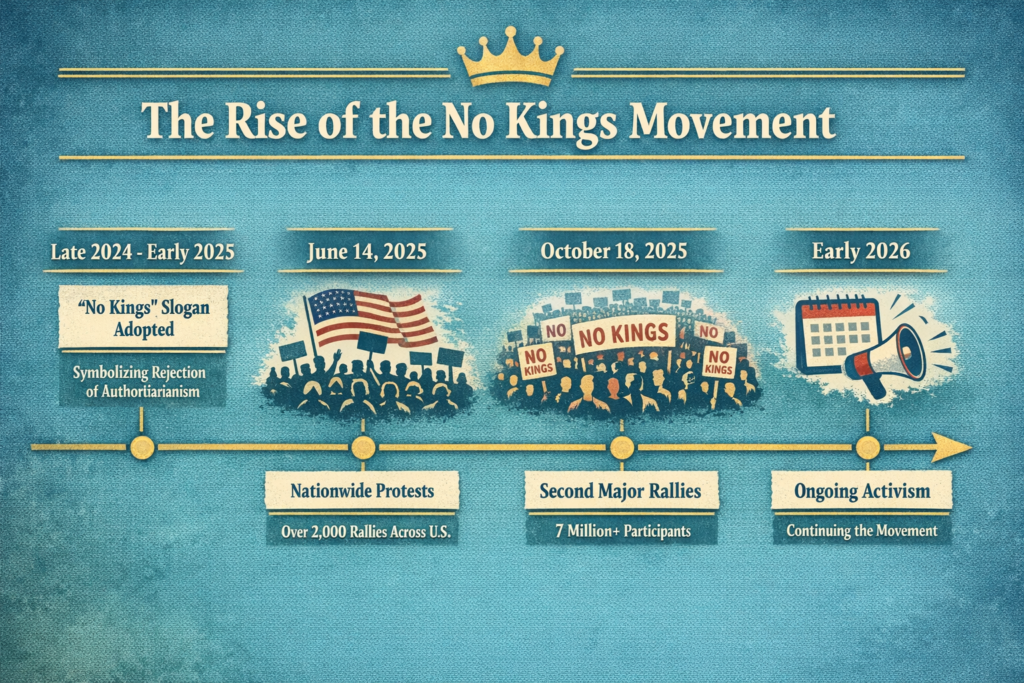
The name “No Kings” is a deliberately evocative reference to a foundational ideal of American political culture: the rejection of monarchical rule. This concept dates back to the American Revolution when the founders explicitly renounced kingship and opted for a republican system in which leaders are accountable to the people. In late 2024 and early 2025, political activists revived this historical metaphor to articulate a modern critique of executive power, turning it into a rallying cry for democratic guardianship.
The phrase quickly transcended its historical origin and became a unifying slogan among various activist groups. Its simplicity — *“No Kings” — succinctly communicated a resistance to what some Americans saw as efforts by those in power to overextend executive authority at the expense of democratic norms and institutional checks.
The First Nationwide Outcry: June 14, 2025
The movement’s first major public manifestation came on June 14, 2025, a date rich with symbolic resonance. This day coincided with Flag Day, the 250th anniversary of the U.S. Army, and President Donald Trump’s 79th birthday. Rather than celebrating in Washington, D.C., as planned, activists organized thousands of protests across the country under the “No Kings” banner, transforming what might have been a ceremonial event into the largest coordinated civic demonstration since Trump’s return to the presidency.
Organizers reported that around 2,100 events spanned every U.S. state, with participation estimates ranging into the millions. These protests were not limited to major cities — small towns and suburban communities also hosted gatherings, marching under slogans like “Democracy, not Dynasty” and “No Thrones, No Crowns, No Kings.”
Broad national frustration about federal policies — from immigration enforcement to executive branch actions — had created fertile ground for a movement that could encapsulate multiple grievances under one banner. This helped the protests attract participants not just primarily aligned with one partisan group but from a wider range of political backgrounds.
Grassroots Organizing and Coalition Building
A defining feature of the No Kings movement’s beginnings was its decentralized yet coordinated nature. Rather than emerging from a single leader or organization, it formed through coalitions of existing groups, including the liberal-leaning Indivisible network, civil liberties advocates such as the American Civil Liberties Union (ACLU), and other local and national activists.
Among these, a group known as the 50501 Movement played a particularly visible role in shaping the narrative and branding of the protests. Acting as a network that emphasized participatory action — often summarized as “50 states, 50 protests, one movement” — this coalition helped spur the early nationwide coordination that made the June 14 demonstrations possible.
The involvement of established organizations also helped with logistics. Groups like Indivisible and the ACLU offered guidance on peaceful protest strategies, legal rights for demonstrators, and how to structure events so that they were visible but lawful. This emphasis on nonviolence was a deliberate choice, intended to distinguish the movement from narratives suggesting civil unrest or disorder.
Growing Momentum and Subsequent Protests
The initial June protests were so expansive that many organizers framed them as a historic moment in their own right. But rather than dissipating, the movement grew stronger in the months that followed. On October 18, 2025, a second wave of nationwide “No Kings” rallies took place, this time with even larger reported participation — organizers claimed attendees in over 2,700 locations and participation reaching around seven million people.
This increase in scale was significant. By late fall, No Kings demonstrations had drawn attention not just nationally but internationally, with solidarity events in other countries, even if they adopted slightly different names such as “No Tyrants” or “No Dictators” in places with constitutional monarchies.
The October demonstrations also reflected a broader critique beyond a single policy or event. Protesters voiced concerns about issues including civil liberties, labor rights, immigration policy, and economic inequality, all coalescing under the central assertion that too much power had been concentrated in the executive branch.
Symbolism and Public Perception
One reason the No Kings movement spread so rapidly was the symbolism embedded in its slogan. Unlike many protests grounded in opposition to specific legislation, the “No Kings” phrase taps into a deep historical narrative about American democracy and resistance to concentrated authority. Using imagery like crowns and thrones — sometimes humorously — helped convert abstract political concerns into a widely understood metaphor.
The movement also benefited from powerful visual language and decentralized storytelling. From social media to local community meetings, activists shared images and phrases that underlined both the seriousness and inclusivity of the movement, allowing individuals with diverse priorities — from environmental activists to civil liberties advocates — to see common ground under the No Kings banner.
Legacy and Future Direction
By early 2026, the No Kings movement had established itself not merely as a slogan but as a continuing political force. With planned events extending into the spring of 2026 and ongoing organization in local communities, the movement’s organizers aim to keep up pressure for democratic accountability, civil rights protections, and broad public participation in governance.
Its origins — rooted in symbolic resistance, decentralized coalition building, and wide public participation — offer a case study in how modern protest movements can mobilize rapidly while maintaining a message broad enough to resonate across social and political groups.
Sources & Further Reading
-
Britannica on the first large No Kings protests and what sparked them.
-
The No Kings movement’s own FAQ and mission statement, putting focus on democratic accountability.
-
PBS NewsHour’s breakdown of why organizers chose the “No Kings” theme.
Please note that this DailyWebTalk blog is for informational purposes only.
Feel free to reach out using our contact form if you are a freelance writer and wish to post on our blog.