How Industrial Edge Computing Powers Real-Time Automation and Efficiency
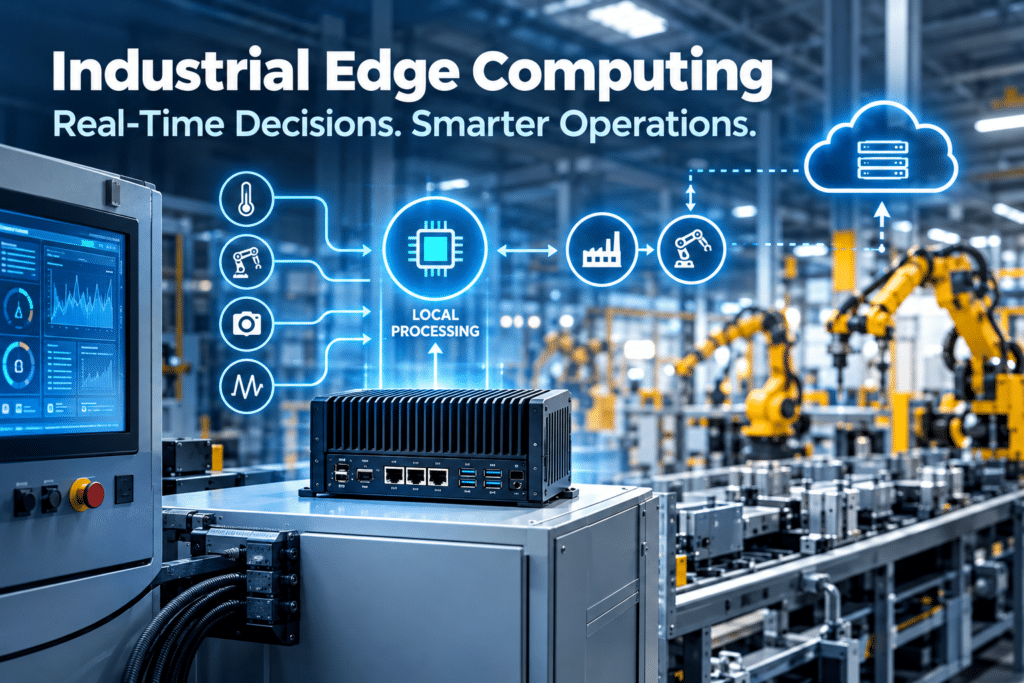
For plant operations supervisors, engineers, and IT newcomers supporting manufacturing automation and logistics data processing, the hardest part is keeping actions aligned with what’s happening right now. When real-time data processing depends on a distant cloud, small delays and dropped connections can turn industrial IoT signals into late alerts, stalled workflows, and confusing handoffs between systems. Factory floor connectivity also isn’t constant, especially across large sites with mobile assets and mixed networks. Industrial edge computing brings computers closer to machines and sensors so automation can keep running where work actually happens.
Understanding Industrial Edge Computing Hardware
Industrial edge computing hardware is the physical computer gear that runs analytics and control logic right beside machines and sensors. Because edge computing shifts data toward the source, decisions happen locally instead of waiting on a faraway system. On the floor, that hardware usually comes in three flavors: industrial PCs, edge servers, and ruggedized gateways.
Industrial PCs sit near a station and handle HMI screens, lightweight analytics, and machine control with reliable, low-latency response. Edge servers take on heavier workloads like vision inspection or many data streams at once. Ruggedized gateways focus on connecting sensors, translating protocols, and buffering data when networks wobble.
Think of it like moving a store manager from headquarters to the checkout lanes. The manager can fix issues instantly, even if the phone line to corporate drops. That is the practical value of localized processing in harsh, noisy environments.
Use a Fanless Industrial PC for On-Floor Analytics
Once you know what rugged edge hardware looks like, the next step is seeing how it behaves when it’s bolted down on the line and making decisions in real time. On a factory floor, industrial PCs can collect signals from equipment, process and analyze that data locally, and feed results straight into automation and control loops, so actions happen immediately, not after data makes a round trip to the cloud. This kind of on-floor analytics supports real-time automation, reliable system control, and seamless connectivity across distributed operations where multiple cells and stations need to stay in sync.
A concrete example is the Helix 500 Series, a fanless industrial edge computer for demanding environments built to keep edge workloads running in challenging conditions. With Intel 10th Gen Core processors and a solid-state design, it’s well-suited for continuously processing machine and sensor data at the edge while offering high I/O density and flexible expansion for the connections those deployments require. Its rugged construction and passive cooling are a practical fit for areas where dust, vibration, and 24/7 operation are part of daily reality, exactly the places where fans and moving parts can become reliability risks. For hardware details, see more background here.
Put Edge Hardware to Work in 5 Common Workflows
Once you’ve proven value with on-floor analytics on a fanless industrial PC, the fastest way to scale is to repeat the same “local compute + smart networking + managed fleet” pattern across a few standard workflows. Here are five edge computing applications you can put to work with a clear starting point.
- Standardize a remote IoT device management loop: Define a simple lifecycle for every edge node and gateway: enroll → configure → monitor → patch → retire. Start by tagging devices by line/cell, owner, and criticality, then set a monthly patch window and a weekly “health check” (disk, CPU, temps, network). This reduces surprise downtime because you’ll spot failing storage, overheating enclosures, and offline nodes before they break production.
- Use edge gateways as your industrial connectivity solution “bridge”: Put a gateway between legacy equipment and your IT network so you can normalize protocols and avoid connecting machines directly to the enterprise LAN. Begin with one cell: map each asset to its interface (serial/Ethernet), then translate data into one internal format and one outbound path to your historian/MES. You’ll improve operational efficiency by cutting one-off wiring, fragile point integrations, and “that one PLC only talks to…” troubleshooting.
- Package your on-floor analytics into a repeatable deployable unit: Take the analytics workload you validated on a fanless industrial PC and wrap it as a standard template: same OS image, same container/app versions, same startup scripts, same dashboards and alerts. Roll it out line-by-line using a staged approach, pilot (1 node) → cell (3–5 nodes) → line (10+ nodes), and keep a rollback image ready. This makes digital infrastructure scaling predictable because every new node is “copy, configure, verify” instead of a fresh build.
- Add local “store-and-forward” buffering to survive network hiccups: Configure edge nodes to keep a rolling buffer of production data (for example, 24–72 hours), then forward when connectivity returns. Pair it with a simple rule: if uplink quality drops below a threshold (packet loss/latency), keep analytics running locally and postpone noncritical uploads like bulk logs. You maintain automation responsiveness and reduce data gaps without overbuilding your WAN.
- Run condition-based maintenance triggers at the edge (then escalate upstream): Start small: pick one failure mode with a measurable signature (vibration, motor current, cycle time drift) and implement a local rule or lightweight model that raises an event when thresholds are exceeded. Escalate only the event and the “before/after” slice of data to your central systems so engineers can review without pulling raw high-frequency streams all day. One real-world example describes a €1.7 M annual saving from an edge AI hybrid approach, which is a good reminder to keep heavy data local and send only what the business needs.
Industrial Edge Computing: Practical FAQs
Got questions before you roll out edge computing plant-wide?
Q: What usually slows down industrial edge computing deployment?
A: The biggest delays tend to be unclear ownership between OT and IT, inconsistent device images, and missing installation standards for power, network, and enclosures. Start by defining who approves changes, then document one “known-good” build and site checklist. Investing early in scalable infrastructure can reduce surprises as you expand.
Q: How much industrial IT support do we really need to keep edge running?
A: You need a lightweight, repeatable support loop: inventory, monitoring, patching, and a clear escalation path. Keep it simple by standardizing alerts and using a single ticket workflow for edge issues. Measure success using better resolution times and fewer repeat incidents, not just uptime.
Q: Can edge devices stay reliable in heat, dust, and vibration?
A: Yes, if you choose industrial-rated hardware and install it like a piece of production equipment, not office IT. Specify temperature range, ingress protection, shock ratings, and proper mounting, then validate with a short burn-in period. Stock one or two spares per critical line so a failure becomes a swap, not a scramble.
Q: What hardware maintenance tasks should we plan for upfront?
A: Plan for periodic inspections of airflow paths, connector tightness, and cable strain, plus storage health checks for SSD wear. Set a maintenance calendar and keep a “golden” replacement image so a new unit can be commissioned quickly. Also document end-of-life dates so refreshes are scheduled, not forced.
Q: When the network drops, will automation stop?
A: It should not, as long as the edge node can operate locally and buffer data until connectivity returns. Set rules for what must run on-site versus what can wait for upload, then test failure scenarios during a planned window. That way, a link issue becomes a temporary sync delay instead of a production event.
Prove Edge Value With a Focused Industrial Pilot
Industrial teams need faster decisions and tighter control, but central systems can’t always keep up with plant-floor reality. The practical path is to treat industrial edge computing as a staged approach: place the right edge hardware near machines to capture real-time industrial data, run local logic, and then integrate what matters upstream. Done well, the benefits of edge computing show up as steadier automation in manufacturing, fewer surprises, and more scalable industrial infrastructure that supports industrial digital transformation without a risky overhaul. Start small at the edge, learn fast, then scale what works.
Please note that this DailyWebTalk blog is for informational and educational purposes only and should not be considered financial, legal, tax, medical, or professional advice. While we strive to provide accurate and up-to-date information, errors or omissions may occur, and content may become outdated. Always consult a qualified professional before making important financial or legal decisions.
We’re always looking for high-quality guest contributors. If you’re a freelance writer interested in submitting a guest post that provides valuable, original content for our readers, we’d love to hear from you. Please contact us through our contact form to inquire about contributing.
